About
Every metadata remover on the web tells you your files never leave your device. We built this one so you do not have to believe that.
The problem with the promise
"Your files never leave your device" is easy to say and hard to check. Some tools that say it upload your photo to a server anyway. Others genuinely do the work in your browser, but load advertising and analytics code from several third parties on the same page as your file.
What we do differently
The code that touches your file runs in a frame served with connect-src 'none'. Your browser refuses every network request that frame could make. Advertising, which pays for this site, runs only in the outer page and cannot reach into that frame. Open your developer tools and watch the request count stay at zero while you clean a photo.
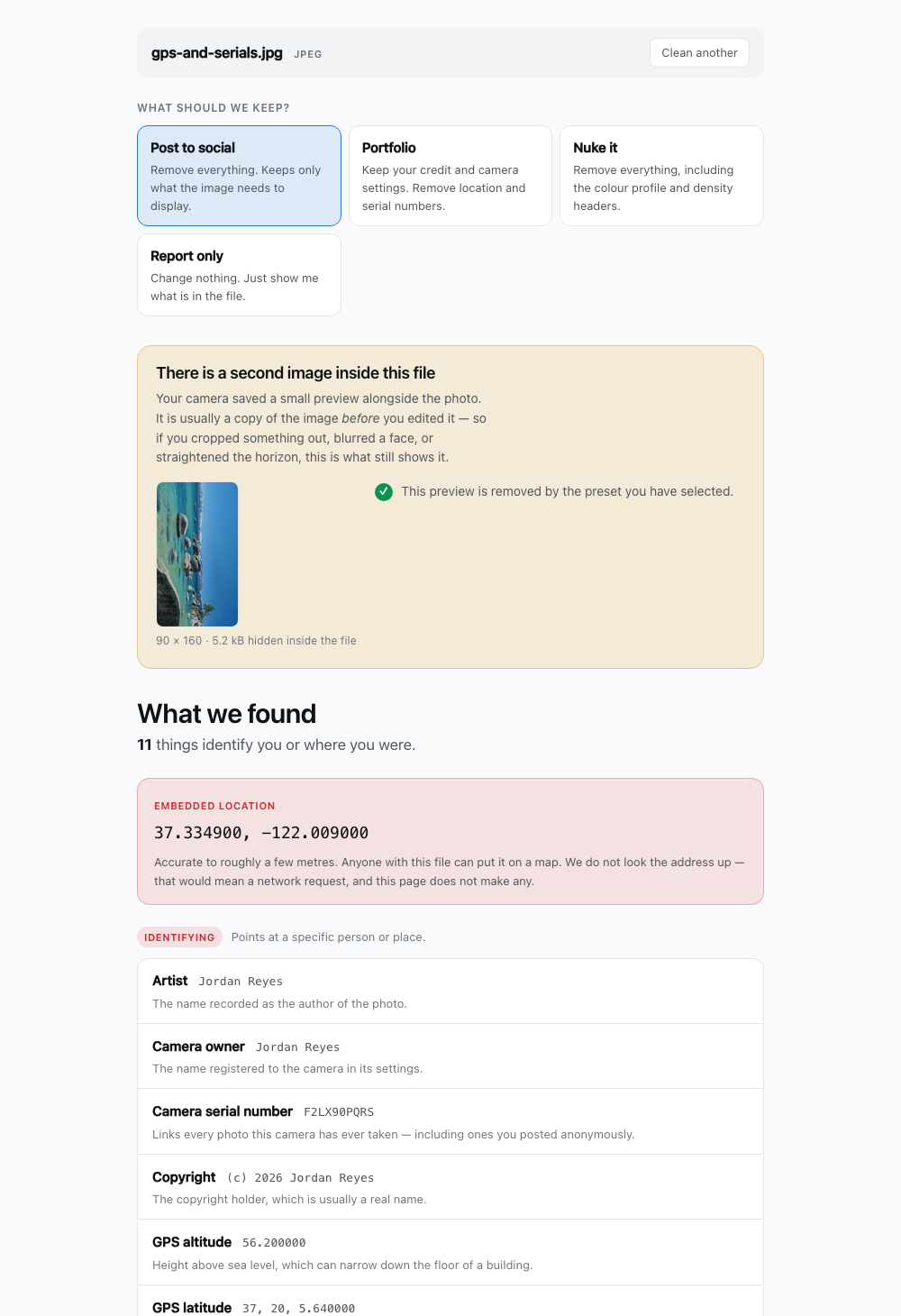
We also show our work. After cleaning, we hash the compressed image data before and after and show you both — matching hashes mean your pixels are bit-for-bit identical and nothing was re-encoded. Then we read the cleaned file back and report anything still in it, including our own misses.
What we will not do
We will not rewrite camera RAW files. Their layouts are vendor-specific and poorly documented, and a wrong guess corrupts an original you cannot get back. We will tell you what is inside a RAW; we will not touch it.
We also will not claim a byte-identical result for PDFs and Office documents. Removing their properties means re-serializing the file, so the hash comparison we offer for photos does not apply. We say so on the result rather than quietly implying otherwise.
Verify us
The stripping engine is a standalone package with a test suite that cross-checks every result against exiftool, the reference implementation for this problem. If exiftool can still read something after we strip it, that is a bug and the build fails. See how this site relates to exiftool for what it does that we deliberately don't try to.
That covers the metadata claim. For the no-upload claim —here's exactly how to check it yourself, in your own browser's DevTools, in about two minutes.
Who maintains this
Built and maintained by tarunvashishth.